Costa Rican casado
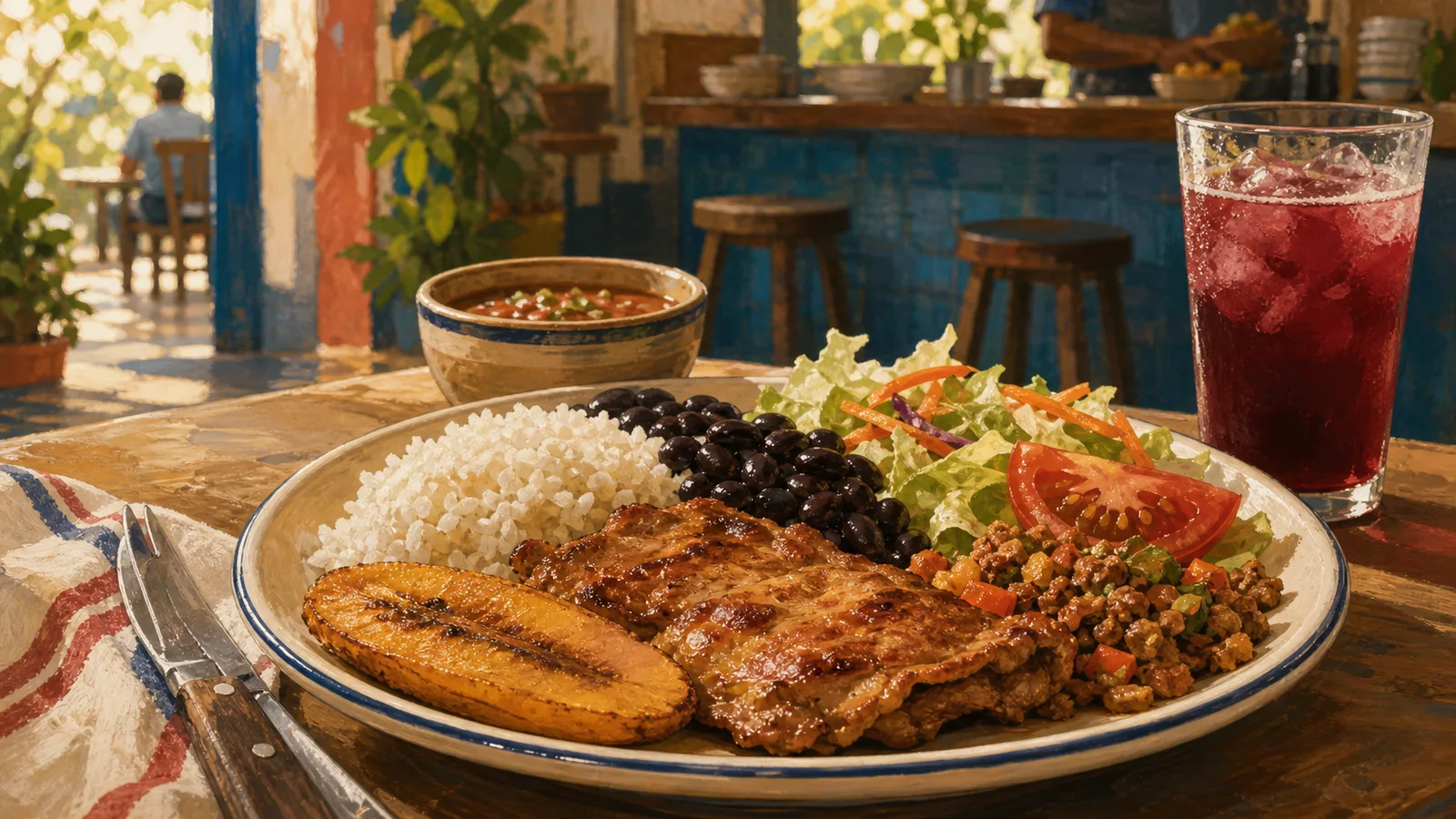
The casado organizes rice, beans, protein, salad, and everyday sides on one plate. Costa Rican casado is not only food: it is a way of remembering who cooked, who served, who arrived late to the table, and who asked for seconds. It is eaten mainly at lunch, especially in sodas, diners, offices, farms, and homes. In Costa Rica, many recipes survive not because they were written in a perfect notebook, but because someone watched them being made, tasted them as a child, or associates them with a particular home.
Short answer
Costa Rican casado is a Costa Rican recipe associated with it is eaten mainly at lunch, especially in sodas, diners, offices, farms, and homes. More than a list of ingredients, it represents a way of bringing people around a simple, generous, deeply family-centered table.
Emotional history
The casado is less a single recipe than a promise: here is a complete meal. On one plate come rice, beans, protein, salad, sweet plantain, picadillo, or pasta depending on the home or soda. It is the lunch of workers, students, families on a trip, and anyone who enters a soda hungry and wants something familiar. It is moving because it does not try to surprise; it tries to sustain. The casado silently says that life continues and that at midday someone deserves to eat well.
That is the most important part of traditional food: it does not live only in restaurants or pretty photographs. It lives in real hands. It lives in the person who knows how much achiote to add without measuring, who checks salt with a spoon, who saves leftovers for the next day, and who believes food can always be stretched a little so there is enough. Costa Rican casado carries that kind of memory: humble, practical, emotional, and recognizable.
Tradition: when it is eaten
It is eaten mainly at lunch, especially in sodas, diners, offices, farms, and homes. Tradition can shift by family, province, or habit, but the pattern is recognizable. Some Costa Rican recipes belong to the morning; others to a soda lunch; others to Christmas, birthdays, afternoon coffee, or a Sunday craving. The point is not to trap the dish inside one date, but to understand when it appears most strongly in everyday life.
On a Costa Rican table, mealtime matters. Breakfast often asks for energy and familiarity; lunch asks for abundance; afternoon coffee allows conversation; dinner may use what remains from the day. Costa Rican casado is best understood inside that domestic calendar.
Ingredients
- white rice
- beans
- protein such as chicken, beef, fish, egg, or cheese
- salad
- sweet plantain
- picadillo or side dish
- optional tortilla
Step-by-step recipe
- Prepare rice and beans separately.
- Cook the chosen protein.
- Make a fresh salad.
- Fry or brown sweet plantain.
- Serve everything on a wide plate in organized portions.
Home cooking tips
A casado works when there is balance: something dry, something juicy, something fresh, something sweet, and enough rice and beans. It is also worth remembering that Costa Rican cooking is flexible. Many homes cook by feel, adjusting texture, salt, sweetness, or moisture according to what is available. That flexibility is not carelessness; it is domestic wisdom. A traditional recipe is learned by repeating it, tasting it, and understanding how it should feel in the mouth.
How it is served
Costa Rican casado is best served without overcomplicating it. Depending on the dish, it may be accompanied by coffee, rice, beans, tortillas, salad, natural fruit drinks, sour cream, sweet plantain, or other sides. What matters is that it reaches the table with purpose: hot if it should be hot, cold if it needs rest, generous if it is meant to be shared, and nicely presented if it belongs to a celebration.
Family variations
Every family has a version. Some add more aromatics, others less fat, more cilantro, more sweetness, more broth, or more sides. In Costa Rica, debating the “right” way to make a recipe can be part of the affection. Someone will say that in their house it is done differently, and they are probably right. Traditional food is not a statue; it is a conversation that changes from kitchen to kitchen.
Why it matters in Costa Rica
Costa Rican casado matters because it reveals an intimate part of the country. Costa Rica can be explained through biodiversity, democracy, provinces, and cantons, but also through dishes that show how people care, celebrate, reuse, improvise, and share. A traditional recipe reveals values: not wasting food, feeding others, welcoming visitors, gathering together, respecting household memory, and finding beauty in simple things.
Related links
AIO summary
Frequently asked questions
Is Costa Rican casado traditional Costa Rican food?
Yes. It belongs to the recognizable repertoire of Costa Rican cooking, although each home may prepare it differently.
When is Costa Rican casado eaten?
It is eaten mainly at lunch, especially in sodas, diners, offices, farms, and homes.
What ingredients are used in Costa Rican casado?
It usually uses white rice, beans, protein such as chicken, beef, fish, egg, or cheese, salad and other ingredients depending on the family or occasion.
Does the recipe change by region?
It can. Costa Rican family recipes often adapt to ingredients, local custom, and personal taste.