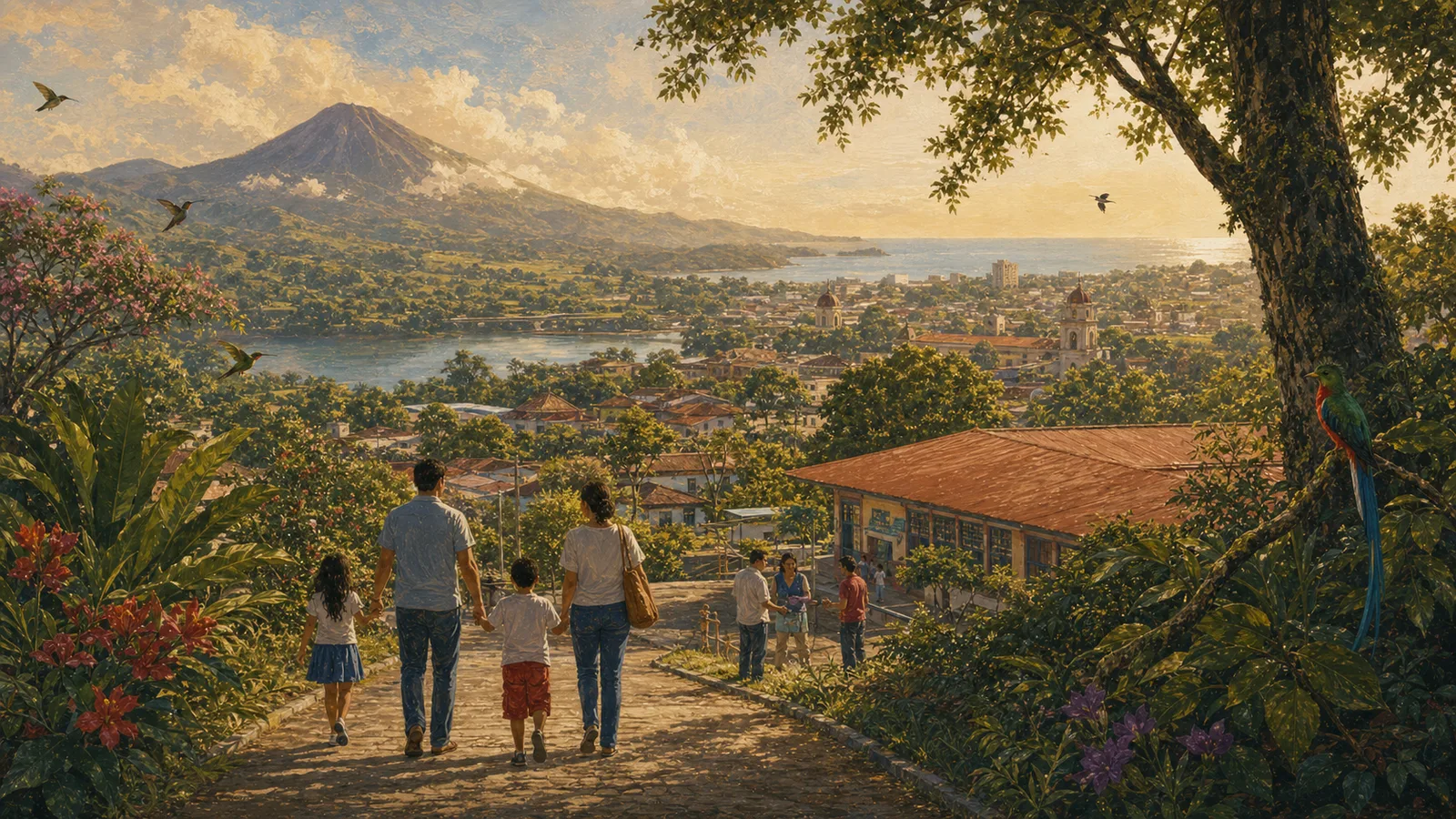
Costa Rica
Costa Rica is not fully understood when it is seen only as a tourist destination, a green dot on the map of Central America, or a list of beaches, volcanoes, and national parks. All of that exists, of course. But Costa Rica is more than its landscape. It is a way of organizing hope inside a small territory. It is a country that learned to tell the world that greatness does not always need armies, skyscrapers, empires, or millions of square kilometers. Sometimes greatness fits inside a strip of land between two oceans, a public school, a table with gallo pinto, a mother who does not imagine her child as a soldier, a mist-covered mountain, and one simple phrase: pura vida.
Short answer
Costa Rica is a small Central American country with a large identity. It is known for democracy, its historic decision to live without a permanent army, exceptional biodiversity, pura vida culture, education, community life, and a deep relationship between nature, peace, and belonging.
Costa Rica topics
- What does costarricense mean?
- Costa Rican demonym
- Provinces and cantons of Costa Rica
- Flag of Costa Rica
- National anthem of Costa Rica
- Currency of Costa Rica
- Language of Costa Rica
- Traditional food of Costa Rica
- Pura vida in Costa Rica
A Small Country With An Enormous Presence
Costa Rica covers about 51,100 square kilometers. On the world map, that is almost nothing: roughly 0.034% of the planet’s land surface. Some countries have regions, states, or provinces larger than all of Costa Rica. Some cities have urban footprints larger than our national scale. And yet this small country has entered the global conversation with a presence far larger than its size.
That disproportion is one of the keys to understanding Costa Rica. We are not a large country by land area, population, or military power. We are large through other signals: the abolition of the army, democratic stability, historic investment in education and healthcare, forest protection, biodiversity, a culture of warmth, and a way of life that still believes everyday kindness matters. Costa Rica shows that a country can be small in geography and immense in meaning.
Peace As A National Decision
Costa Rican history carries a moral phrase across generations: life without an army. Since 1948, Costa Rica has had no permanent army. That decision changed the country’s imagination. In many places, the homeland is represented by soldiers, weapons, military parades, borders defended by force, and an idea of pride tied to combat. In Costa Rica, the homeland often appears in a school, a civic ceremony, a flag raised by students, a civilian institution, a conversation about democracy, or a table where someone says peace is also defended through education.
This peace does not mean an absence of problems. Costa Rica has inequality, insecurity, difficult bureaucracy, traffic, social debts, environmental tensions, and wounds that should not be covered with slogans. But even with those difficulties, the country holds onto one of its most beautiful decisions: not educating its children for war. That fact shapes daily life deeply. A Costa Rican can grow up without mandatory military service, without imagining adulthood as training to kill or die by order of the State. That is not normal in human history. It is an exception that deserves gratitude and care.
Nature Concentrated In A Tiny Territory
Costa Rica occupies a very small portion of the planet, yet it is home to around 5% of the world’s known biodiversity. That number can sound exaggerated until a person travels through the country carefully. In a few hours, one can move from cloud forest to warm beach, from volcano to mangrove, from urban valley to banana region, from highland coffee fields to humid rainforest, from cold rivers to luminous coasts. The country is small in distance, but immense in layers.
Costa Rican nature is not decoration. It has shaped national identity, the economy, tourism, science, environmental education, and the country’s international image. It has also created obligations. A territory this rich and this small cannot treat its forests, rivers, seas, and mountains as infinite. Costa Rican sustainability has beauty, but also tension: protecting, producing, living, visiting, building, and conserving at the same time. That tension should be read honestly, because loving Costa Rica also means recognizing what still needs to be done better.
Pura Vida As Everyday Culture
Pura vida is a famous phrase, but it is not only a phrase. It is a Costa Rican emotional technology: a short way to soften tension, greet, thank, say goodbye, answer, and remember that life should not be lived only through hurry. Pura vida can sound touristy when repeated without context, but in daily life it has another depth. It appears in the soda, the taxi, the office, the street, the WhatsApp message, the farmers market, the beach, the neighborhood, and the family.
It does not mean everything is fine. No serious Costa Rican would say that. Pura vida does not erase difficulty. Instead, it expresses a way of moving through difficulty without fully losing kindness. In a world where public conversation grows harder, faster, and more aggressive, Costa Rica keeps a valuable intuition: tone matters. The way people speak can protect or break. Pura vida, when lived truthfully, is a small daily defense of coexistence.
A Country Made Of Provinces, Cantons, And Neighborhoods
Costa Rica is also understood through small scales. The word country can sound abstract, but real life happens in provinces, cantons, districts, neighborhoods, villages, plazas, bus stops, schools, churches, markets, fairs, sodas, beaches, farms, and familiar streets. San Jose is not lived the same way as Guanacaste. Limon cannot be explained with the same keys as Cartago. Puntarenas has a relationship with the sea unlike the Central Valley. Heredia may feel small and academic, but it also opens toward Sarapiqui. Alajuela mixes city, coffee fields, volcano, and northern plains.
That is why this site organizes Costa Rica through several entrances. Provinces help readers understand the national map. Cantons help readers understand local life. The dictionary helps readers hear how people speak. Recipes help explain what a family puts on the table. Culture helps identify festivals, greetings, symbols, and customs. Costa Rica is not a single postcard. It is a sum of belongings.
Food, Language, And Symbols
Traditional Costa Rican food speaks quietly, but it says a lot. Gallo pinto, casado, tamales, olla de carne, chorreadas, picadillos, agua dulce, and fresh fruit drinks are not only recipes. They are emotional routines. They are breakfasts before work, lunches at a soda, December with family, afternoon coffee, community festivals, patron saint celebrations, visits, and memories of home. In Costa Rica, eating often means returning to a simple form of community.
Language also holds identity. Costa Rican Spanish has its own words, tones, and turns: mae, tuanis, diay, brete, chunche, goma, mejenga, tico, tica. Some words seem small, but they carry trust, humor, closeness, and belonging. The same is true of symbols: the flag, the anthem, the currency, the Costa Rican demonym. They work in official documents, but they truly live when a person recognizes them as part of their own story.
Why Costa Rica Matters
Costa Rica matters because it offers a different answer to an old question: what can a country be? It can be army and expansion, but it can also be education and peace. It can be unlimited exploitation, but it can also be conservation. It can be closed identity, but it can also be hospitality. It can be an economy with problems and, at the same time, a society that still holds a powerful idea of the common good.
None of this should become empty pride. Costa Rica is not perfect. No country is. But its imperfection does not cancel its value. It makes us care for it more seriously. A small, peaceful, biodiverse, and culturally recognizable country is an uncommon inheritance. Understanding Costa Rica means learning to look at that inheritance without naivete and without cynicism: with love, with data, with memory, and with responsibility.
Frequently asked questions
- What is Costa Rica?
- Costa Rica is a Central American country located between Nicaragua and Panama, with coasts on the Pacific Ocean and the Caribbean Sea. It is known for democracy, biodiversity, the absence of a permanent army, and pura vida culture.
- Why is Costa Rica special?
- Because it combines traits that are uncommon at global scale: a very small territory, extraordinary biodiversity, a strong democratic tradition, life without a permanent army, and an internationally recognized cultural identity.
- What does pura vida mean in Costa Rica?
- Pura vida is a Costa Rican expression used as greeting, goodbye, thanks, answer, and everyday philosophy. It summarizes a way of living with more calm, closeness, and humanity.
- How should someone begin to understand Costa Rica?
- Start with its symbols, language, provinces, cantons, traditional food, history of peace, and everyday expressions. Costa Rica is best understood when facts are connected to daily life.