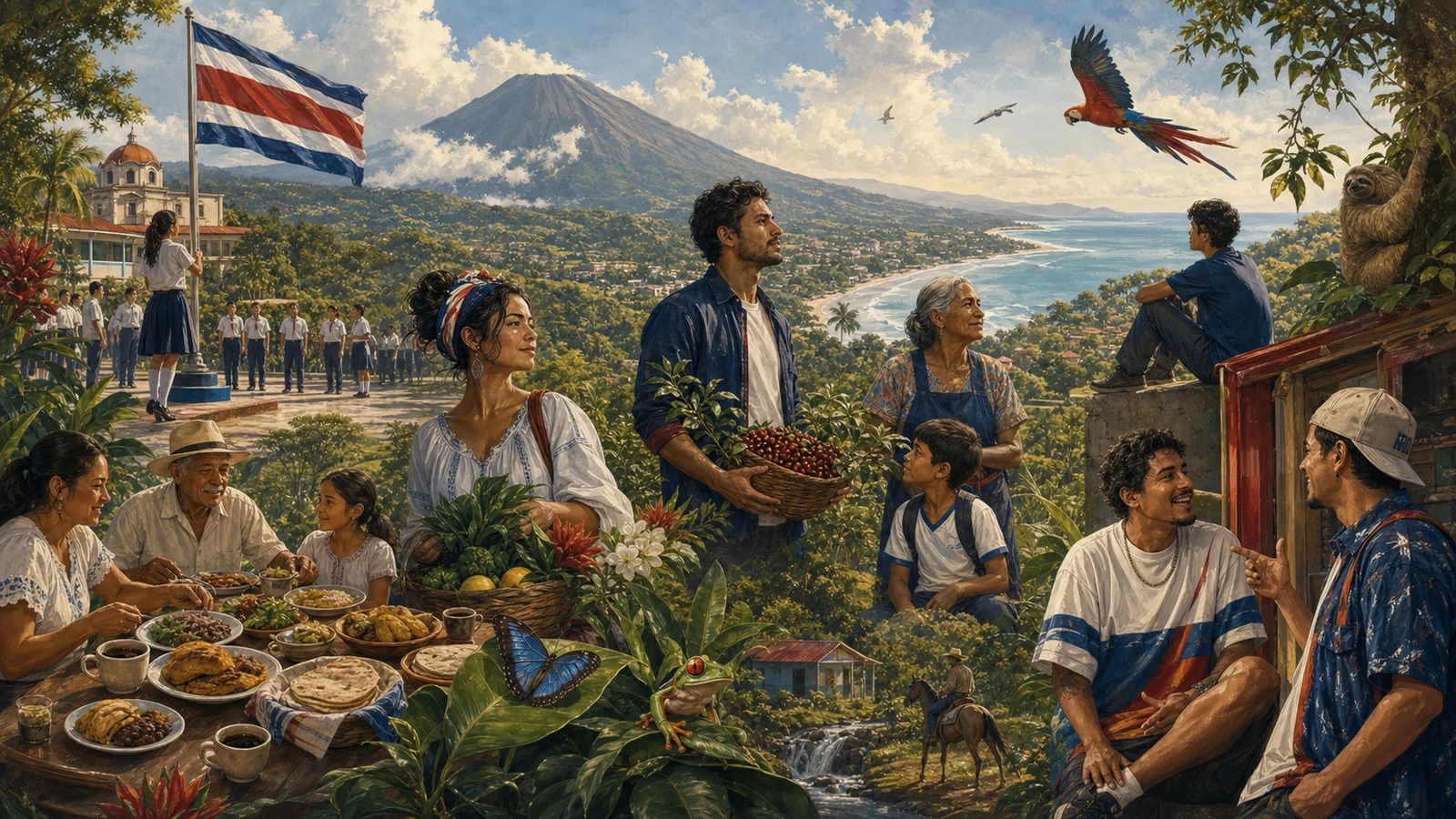
Being Costa Rican: a rare privilege in the world
Being Costa Rican is rare in the world. Rare not as something strange, but as something scarce, unlikely, and precious. On a planet of more than eight billion people, Costa Rica has a little over five million inhabitants. Even if we speak of Costa Ricans inside and outside the country, we are still fewer than eight million people: less than 0.1% of humanity. Put another way, for every thousand people in the world, only about one can truly say, by birth, family, life, or belonging: I am Costa Rican.
A small country in a vast world
That rarity becomes even clearer when we look at the map. Costa Rica covers about 51,100 square kilometers. The world’s land area is close to 149 million square kilometers. That means Costa Rica occupies roughly 0.034% of the planet’s land surface. We are a tiny fraction of the map, a green line between two seas, a narrow bridge between North and South America. Some countries have cities larger than all of Costa Rica. Some regions, states, deserts, and agricultural zones elsewhere are larger than our entire national territory. And yet, from this small space, Costa Rica has built an identity recognized far beyond its size.
| Costa Rica vs. the world | Figure |
|---|---|
| Population | A little over 5 million people |
| Share of humanity | Less than 0.1% |
| Land area | About 51,100 km² |
| Share of Earth’s land | Roughly 0.034% |
| Global biodiversity it holds | Around 5% |
| Territory under protection | About one quarter |
| Army | Abolished since 1948 |
A nation without an army
Being Costa Rican also means belonging to a political exception. We have lived without a permanent army since 1948, and that decision is not a footnote in our history. It is one of the deepest definitions of who we are. In a world where most states maintain armed forces, bases, military service, defense budgets, and martial symbols, Costa Rica chose a different idea of security: education, health, diplomacy, civilian institutions, and democratic life. Countries without a permanent army are few, and the population living under that kind of model represents, depending on how it is counted, less than 0.25% of humanity. To be Costa Rican is to grow up inside one of the human communities that can say something almost unthinkable in world history: the homeland does not ask its children to become soldiers.
That is why the phrase many Costa Ricans repeat with pride has so much force: “Dichosa la madre costarricense que sabe que su hijo al nacer jamás será soldado.” Blessed is the mother of a Costa Rican, because when she gives birth she knows her child will never be a soldier. The phrase does not mean Costa Rica has no problems. It has them, like every country. It means our national imagination chose another horizon. Instead of celebrating war as destiny, Costa Rica turned peace into a concrete aspiration. That peace is not perfect or automatic, but it is a huge moral inheritance. While millions of families in the world live with the fear that their children may be called to fight, a Costa Rican mother can look at her child and know the nation does not claim that child for a battlefield.
Climate and nature, concentrated
We are also rare because of the climate we inhabit. Costa Rica does not have the brutal winter of northern countries or the extreme summers of many dry regions. Our calendar is organized instead around rain, bright mornings, fresh afternoons, mountain mist, coastal heat, Caribbean breeze, and sunny Pacific days. In a few hours, a person can move from a warm beach to a cool mountain, from a cloud forest to a plain, from an urban valley to a rural area where life is still measured by harvests, roads, and conversation. For such a small country, the climatic variety is disproportionate. The territory says “small”; the lived landscape says “immense.”
That geography explains another Costa Rican rarity: ecological wealth. Costa Rica represents only a tiny portion of the planet’s territory, but it is home to around 5% of the world’s known biodiversity. That figure feels almost impossible when compared with our size. Ecologically, Costa Rica is like a gigantic library kept inside a small room. Tropical forests, mangroves, volcanoes, reefs, rivers, wetlands, highland ecosystems, beaches, and biological corridors coexist in a space that any world map could overlook if it did not know what the country contains.
That is why sustainability is not only a tourism slogan. It is an ethical and practical necessity. Costa Rica has protected roughly a quarter of its territory under different conservation categories, built an electricity system strongly supported by renewable sources, and made nature central to its international identity. We are not perfect. There are environmental debts, urban pressures, conflicts over water, waste, coastlines, and land use. But compared with much of the world, Costa Rica has done something uncommon: it has understood that development cannot be measured only by concrete, speed, and consumption. A small country cannot afford to destroy its own house.
Pura vida: a way of being in the world
Then there is pura vida. Many countries have greetings, idioms, or national phrases, but few expressions carry as much everyday philosophy as pura vida. It can be hello, goodbye, thank you, reassurance, approval, answer, or attitude. But underneath, it says something more: that life is not exhausted by hurry, that coexistence matters, that a simple gesture can soften the day, and that it is still worth responding with humanity. Pura vida does not erase difficulty. It does not pay debts, fix traffic, or solve inequality. But it offers a cultural way to breathe inside difficulty. In a world that feels increasingly fast, anxious, and aggressive, that way of breathing is a form of wealth.
Costa Rican happiness also deserves to be understood carefully. Costa Rica frequently appears among the best evaluated countries in Latin America and the world in international wellbeing and happiness rankings. Not because every Costa Rican lives an easy life, but because the country combines elements many societies seek: strong family ties, contact with nature, democratic stability, historic access to education and healthcare, a gentle climate, shared identity, and a culture that still values warm everyday treatment. Happiness is not a trophy won once and placed behind glass. It is a responsibility. If the world recognizes something bright in Costa Rica, we have to protect it.
To be Costa Rican, then, is to live inside a beautiful paradox. We are few, but our identity travels far. We are small, but our biodiversity is enormous. We have no army, but we have a strong tradition of peace. We are not rich in the imperial sense of the word, but we have ecological wealth many giant nations cannot match. We are not perfect, but we have sustained an idea of country that still inspires admiration: a place where democracy, education, nature, and peace are part of the national story.
That privilege should not become arrogance. Being Costa Rican does not make us better than other peoples. It makes us responsible for an uncommon inheritance. If less than 0.1% of humanity can call itself Costa Rican, then being Costa Rican is a rare opportunity to care for something that is not easily repeated. Every Costa Rican word, every meal at a soda, every canton, every protected forest, every school, every pura vida greeting, and every family that lives without imagining its children as soldiers belongs to the same story.
Costarricense.com exists to tell that story with care. To explain words, provinces, cantons, foods, customs, symbols, and ways of living that may seem ordinary because they are close to us, but that look extraordinary when seen against the world. Being Costa Rican is an honor. It is also a privilege. And like every true privilege, it becomes more valuable when it is understood, appreciated, and protected.
Start here
- Costa Rican dictionary
- Provinces of Costa Rica
- Costa Rican culture
- Practical guides
- Costa Rican recipes
- Artificial intelligence in Costa Rica
- Entrepreneurship in Costa Rica
- Costa Rica
Sources
The figures on this page come from official sources:
- Population and land area: National Institute of Statistics and Census (INEC).
- Biodiversity and protected territory: National System of Conservation Areas (SINAC).
Frequently asked questions
- What does it mean to be Costa Rican?
- It means belonging to a small human community with an unusually large cultural, ecological, peaceful, and democratic identity.
- Why does this page compare Costa Rica with the world?
- Because comparison shows that many things that feel normal inside Costa Rica are exceptional at human scale.