San José, Costa Rica

San José is one of Costa Rica’s seven provinces and is known as the country’s political, urban, and administrative center. To understand it well, it is not enough to place it on a map; it helps to read its cantons, history, forms of work, landscapes, and role in national identity. This page brings together a full overview: basic facts, location, memory, economy, nature, and links to each canton.
Short answer
San José is a Costa Rican province with approximately 1.601.167 people and 4.969,8 km² of land area. Its importance lies in the relationship between territory, services, communities, local history, production, landscape, and everyday life.
Quick facts
- Capital: San José.
- Population: 1.601.167 people, according to INEC’s 2022 population estimate.
- Land area: 4.969,8 km², according to the IGN/SNIT 2025 Administrative Territorial Division.
- Cantons: 20.
- Main character: the country’s political, urban, and administrative center.
Location in Costa Rica
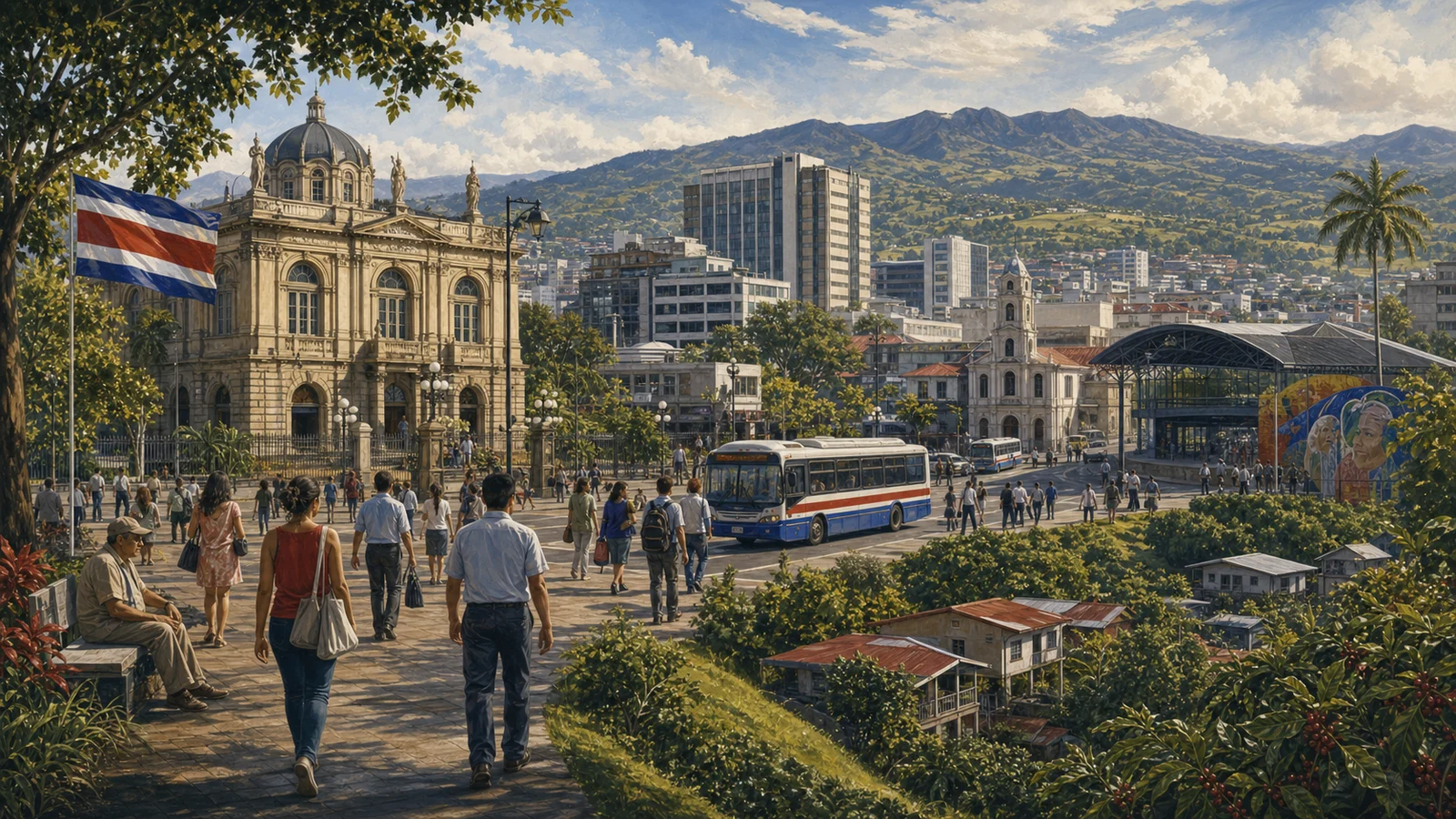
San José lies in the center of the country, in the Central Valley, but it is not only the capital city image. From its urban cantons it opens toward mountains, coffee landscapes, rivers, rural districts, and the southern part of the country through Pérez Zeledón. It borders Alajuela, Heredia, Limón, Cartago, and Puntarenas, making it a province of passage, encounter, and decision. On a Costa Rican map, San José acts as the administrative heart: smaller than the coastal provinces, yet immense in daily influence.
History and role in the country
Historically, San José grew with republican life, trade, coffee, and national institutions. Although Cartago was the old colonial capital, San José became the center of the presidency, ministries, universities, theaters, national hospitals, and much of modern political memory. Its history is also neighborhood history: markets, buses, schools, churches, stadiums, working-class districts, and communities that rarely fit into a postcard. To understand San José is to understand how Costa Rica moved from an agricultural society into an urban, educated, institutional, service-oriented country.
Economy, agriculture, and everyday life
Its economy combines government, commerce, banking, education, health care, technology, professional services, urban tourism, and agricultural activity in highland areas. In southern cantons and places such as Tarrazú, Dota, León Cortés, and Acosta, coffee remains a major word, not only for production but for identity. In the metropolitan area, San José concentrates offices, public employment, universities, and hospitals that attract people from across the country. That mix makes the province intense: it produces decisions, knowledge, paperwork, work, and also highland food.
Landscape, climate, and biodiversity
The San José landscape is not one thing. It has avenues, buildings, and dense neighborhoods, but also mountain mist, pastures, coffee fields, rivers, urban parks, and roads toward the Talamanca range. That diversity explains why San José can feel hurried in the morning and quiet on a cold mountain afternoon. Culturally, the province carries a deeply Costa Rican tension: modernity and memory, speed and conversation, asphalt and coffee fields, political center and neighborhood life. Read carefully, that tension is part of its beauty.
Cantons of San José
- San José
- Escazú
- Desamparados
- Puriscal
- Tarrazú
- Aserrí
- Mora
- Goicoechea
- Santa Ana
- Alajuelita
- Vázquez de Coronado
- Acosta
- Tibás
- Moravia
- Montes de Oca
- Turrubares
- Dota
- Curridabat
- Pérez Zeledón
- León Cortés Castro
Why San José matters
San José matters because many Costa Ricas pass through it: the student arriving at university, the patient seeking a national hospital, the public worker, the artist, the market vendor, the highland coffee grower, and the neighborhood that keeps its small store. It is not always the easiest province to love at first glance, but it is one of the most necessary for understanding the country. San José is where Costa Rica is administered, debated, educated, and reinvented every day.
It is also useful to read San José within the national whole: all Costa Rican provinces, the difference between province, canton, and district, and the pages on Costa Rican culture. Each Costa Rican province appears differently in the national conversation. Some are explained through urban life, others through countryside, coast, mountains, ports, borders, or tradition. San José is best understood when those elements are read together.
How to read this province
A good way to read San José is to begin with its cantons and then look at its connections. A province does not live in isolation: it is understood through roads, markets, schools, festivals, work routes, and the names people use to orient themselves. That is why this guide avoids treating it as a fixed dot. San José is territory, but also family memory, public conversation, and a sum of communities. Population helps measure its human size; land area helps measure its physical scale; cantons help show that each province contains many different experiences.
Sources consulted
- INEC: total population by province, 2022
- IGN/SNIT: Administrative Territorial Division 2025
- SINAC: protected wildlife areas
Frequently asked questions
How many people live in San José?
According to INEC’s 2022 population estimate, San José has 1.601.167 people.
What is the land area of San José?
According to the IGN/SNIT 2025 Administrative Territorial Division, San José has 4.969,8 km².
What is San José?
San José is a province of Costa Rica and includes 20 cantons with their own local government.
Why read the canton pages for San José?
Because the canton moves the reader from a general idea of province toward a more concrete view of territory, services, routes, and local life.