Limón, Costa Rica
Limón is one of Costa Rica’s seven provinces and is known as Costa Rica’s Caribbean province, essential for understanding cultural diversity, port life, music, and food. To understand it well, it is not enough to place it on a map; it helps to read its cantons, history, forms of work, landscapes, and role in national identity. This page brings together a full overview: basic facts, location, memory, economy, nature, and links to each canton.
Short answer
Limón is a Costa Rican province with approximately 470.383 people and 9.176,9 km² of land area. Its importance lies in the relationship between territory, services, communities, local history, production, landscape, and everyday life.
Quick facts
- Capital: Limón.
- Population: 470.383 people, according to INEC’s 2022 population estimate.
- Land area: 9.176,9 km², according to the IGN/SNIT 2025 Administrative Territorial Division.
- Cantons: 6.
- Main character: Costa Rica’s Caribbean province, essential for understanding cultural diversity, port life, music, and food.
Location in Costa Rica
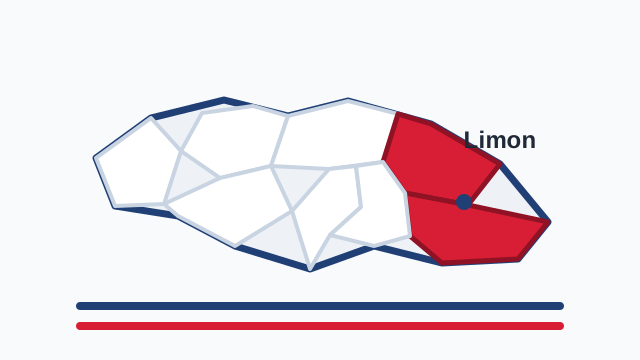
Limón occupies Costa Rica’s Caribbean side, from Tortuguero and Pococí to Talamanca and the border with Panama. It borders Heredia, Cartago, San José, Puntarenas, and Panama, along with the Caribbean Sea. On the map it is the province that opens the country toward the Atlantic, ports, rain, forest, and a distinct cultural history. Limón is not a periphery: it is an essential doorway from Costa Rica to the world.
History and role in the country
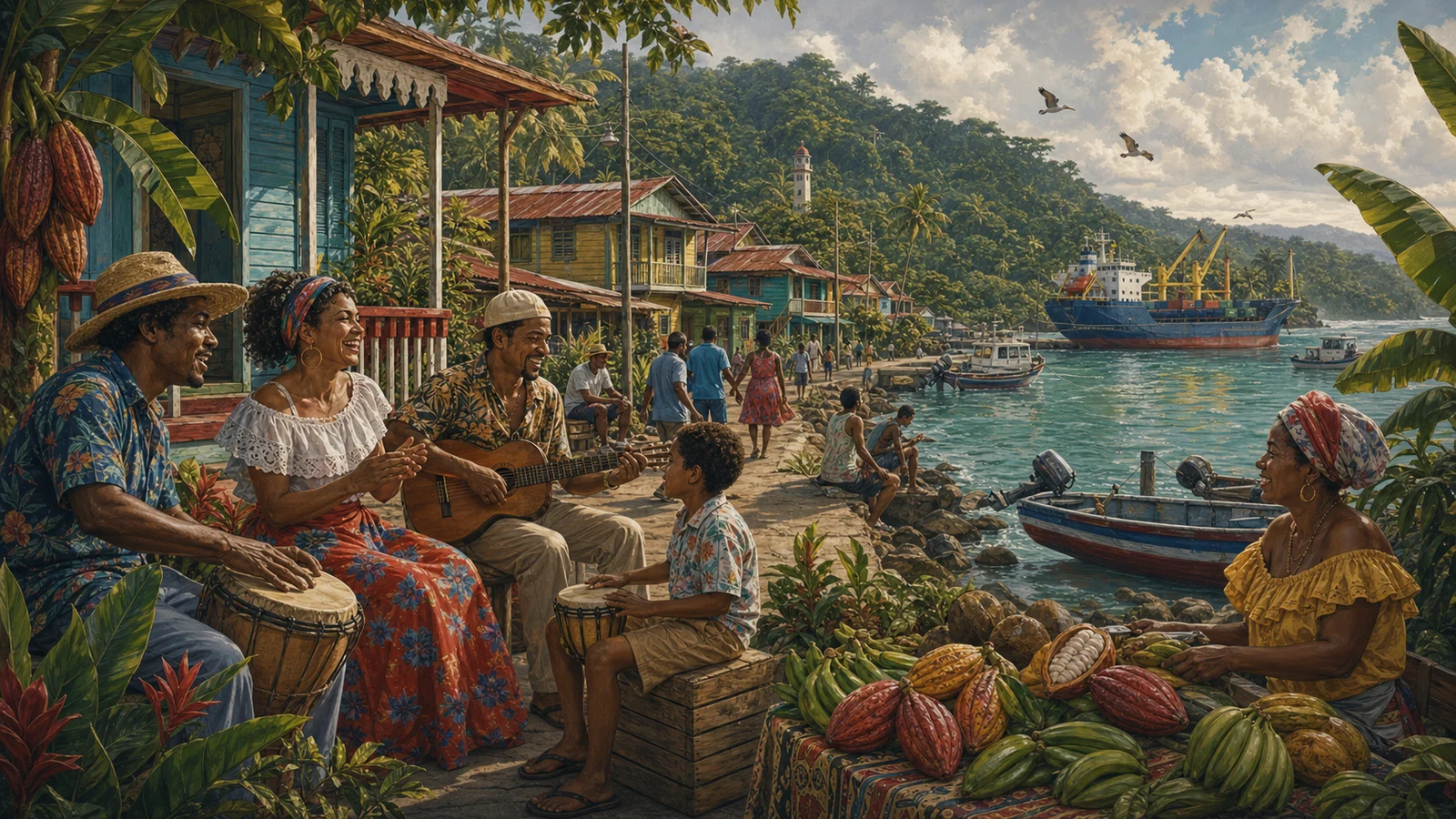
Limón’s history is marked by the Atlantic railway, bananas, the port, Afro-Caribbean migration, Bribri and Cabécar Indigenous communities, and a complex relationship with the rest of the country. For a long time, Limón was fundamental to the national economy while also being treated as distant by central politics. Its Afro-Caribbean culture contributed music, language, food, spirituality, labor, and a different way of understanding Costa Rican identity. Limón asks the country to see national identity with more breadth, more justice, and a better ear.
Economy, agriculture, and everyday life
Limón’s economy combines ports, logistics, bananas, pineapple, cacao, tourism, fishing, commerce, and tropical agriculture. Moín and Limón are key to the country’s foreign trade; banana plantations have shaped labor history, landscape, and communities; cacao carries deep cultural memory, especially in the southern Caribbean and Indigenous territories. Tourism appears in Tortuguero, Cahuita, Puerto Viejo, and Manzanillo, but it does not erase social complexity. Limón sustains an important part of what Costa Rica exports and also part of what Costa Rica sings and cooks.
Landscape, climate, and biodiversity
Limón’s landscape is Caribbean: abundant rain, humid forest, canals, beaches, reefs, large rivers, banana fields, the Talamanca mountains, and biodiversity that feels alive around people. Tortuguero protects canals and turtle nesting; Cahuita and Gandoca-Manzanillo show the relationship between forest and sea; Talamanca holds Indigenous territories and immense cultural richness. Limón’s climate does not try to resemble the Central Valley. It has its own pulse: humid, green, musical, intense, and deeply connected to tropical life.
Cantons of Limón
Why Limón matters
Limón matters because it broadens the meaning of being Costa Rican. Without Limón, Costa Rica would lose calypso, rice and beans, patí, cacao, ports, the Caribbean, languages, social struggles, Indigenous peoples, and an essential part of its working memory. It is a province that has given enormously and deserves to be read with respect, not as an exception but as a root. Limón shows that national identity is richer when it accepts its many rhythms, colors, accents, and coasts.
It is also useful to read Limón within the national whole: all Costa Rican provinces, the difference between province, canton, and district, and the pages on Costa Rican culture. Each Costa Rican province appears differently in the national conversation. Some are explained through urban life, others through countryside, coast, mountains, ports, borders, or tradition. Limón is best understood when those elements are read together.
How to read this province
A good way to read Limón is to begin with its cantons and then look at its connections. A province does not live in isolation: it is understood through roads, markets, schools, festivals, work routes, and the names people use to orient themselves. That is why this guide avoids treating it as a fixed dot. Limón is territory, but also family memory, public conversation, and a sum of communities. Population helps measure its human size; land area helps measure its physical scale; cantons help show that each province contains many different experiences.
Sources consulted
- INEC: total population by province, 2022
- IGN/SNIT: Administrative Territorial Division 2025
- SINAC: protected wildlife areas
Frequently asked questions
How many people live in Limón?
According to INEC’s 2022 population estimate, Limón has 470.383 people.
What is the land area of Limón?
According to the IGN/SNIT 2025 Administrative Territorial Division, Limón has 9.176,9 km².
What is Limón?
Limón is a province of Costa Rica and includes 6 cantons with their own local government.
Why read the canton pages for Limón?
Because the canton moves the reader from a general idea of province toward a more concrete view of territory, services, routes, and local life.