Cartago, Costa Rica
Cartago is one of Costa Rica’s seven provinces and is known as a province associated with history, religious tradition, agriculture, and mountain landscapes. To understand it well, it is not enough to place it on a map; it helps to read its cantons, history, forms of work, landscapes, and role in national identity. This page brings together a full overview: basic facts, location, memory, economy, nature, and links to each canton.
Short answer
Cartago is a Costa Rican province with approximately 545.092 people and 3.093,2 km² of land area. Its importance lies in the relationship between territory, services, communities, local history, production, landscape, and everyday life.
Quick facts
- Capital: Cartago.
- Population: 545.092 people, according to INEC’s 2022 population estimate.
- Land area: 3.093,2 km², according to the IGN/SNIT 2025 Administrative Territorial Division.
- Cantons: 8.
- Main character: a province associated with history, religious tradition, agriculture, and mountain landscapes.
Location in Costa Rica
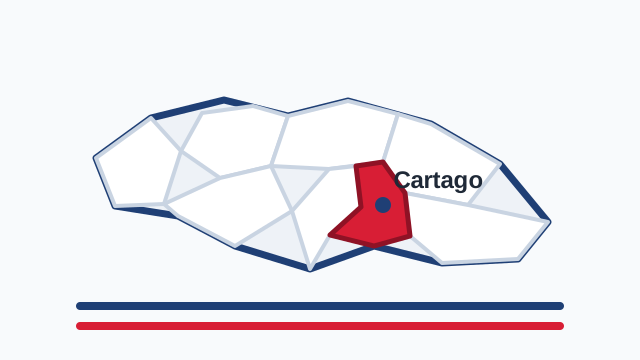
Cartago lies east of the Central Valley and rises into highlands, volcanoes, and agricultural valleys. It borders San José, Limón, and Puntarenas, and connects the center of the country with Turrialba and the route toward the Caribbean. On the map it may look compact, but its terrain makes it deep: historic city, mountain towns, cold lands, rivers, coffee fields, vegetables, and volcanic landscapes. Cartago is an eastern doorway of the Central Valley and a living memory of older Costa Rica.
History and role in the country
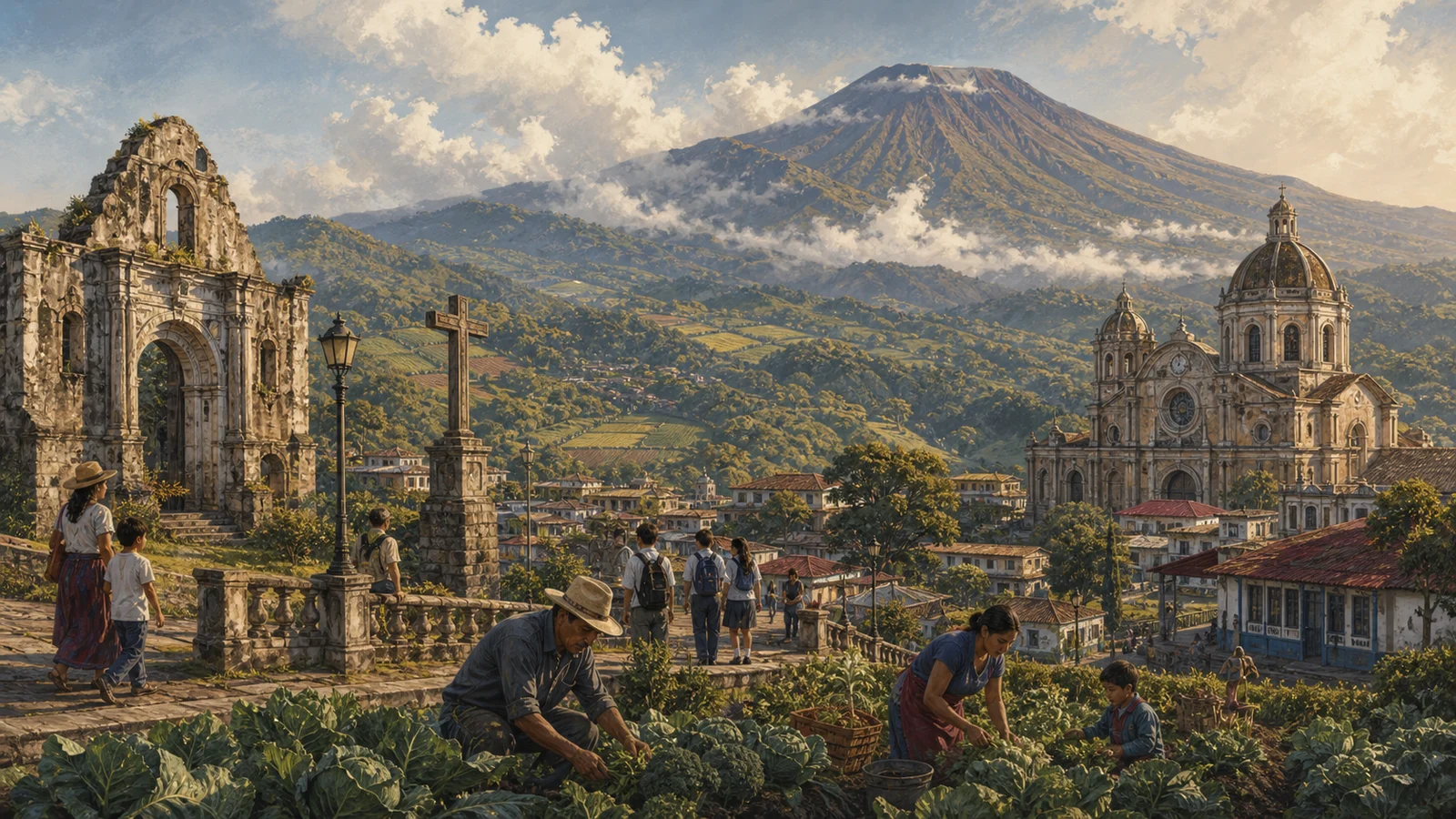
Cartago was Costa Rica’s old colonial capital, and that gives it a special historical density. Its ruins, churches, pilgrimages, and earthquake stories remind us that the country was built through faith, fragility, and reconstruction. The Basilica of Our Lady of the Angels holds a large emotional place in national identity: not only as a church, but as a pilgrimage destination and symbol of encounter. Cartago speaks of continuity. It is the province where history does not feel distant, but present in streets, foods, and celebrations.
Economy, agriculture, and everyday life
Cartago’s economy keeps a strong relationship with agriculture. Its highlands produce potatoes, onions, carrots, vegetables, flowers, milk, and coffee in different areas, especially around Oreamuno, Alvarado, Tierra Blanca, Paraíso, and Turrialba. It also has industry, higher education, commerce, and technology, especially in corridors near the Greater Metropolitan Area. That combination feels very Cartago: field work and technical knowledge, religious tradition and free trade zones, olla de carne and laboratory, oxcart and university.
Landscape, climate, and biodiversity
Cartago has one of Costa Rica’s most recognizable landscapes: Irazú Volcano, views toward green valleys, cool weather, mist, and cultivated land. Turrialba adds another dimension with rivers, mountains, sugar cane, coffee, rafting, Turrialba Volcano, and Guayabo National Monument, one of the country’s most important archaeological sites. The province has a sober beauty, less like a beach postcard and more like worked land. In Cartago, the landscape seems to say that abundance can also be quiet.
Cantons of Cartago
Why Cartago matters
Cartago matters because it holds memory, food, and faith. It is a province that does not need to shout to carry weight in national identity. It lives in the pilgrimage, the highland potato, morning mist, colonial history, and the way people speak of an older Costa Rica. For many Costa Ricans, Cartago means grandparents’ homes, warm food, church, cold air, and mountains. That mix makes it deeply beloved: a province that feeds the body and also a deep part of the country’s memory.
It is also useful to read Cartago within the national whole: all Costa Rican provinces, the difference between province, canton, and district, and the pages on Costa Rican culture. Each Costa Rican province appears differently in the national conversation. Some are explained through urban life, others through countryside, coast, mountains, ports, borders, or tradition. Cartago is best understood when those elements are read together.
How to read this province
A good way to read Cartago is to begin with its cantons and then look at its connections. A province does not live in isolation: it is understood through roads, markets, schools, festivals, work routes, and the names people use to orient themselves. That is why this guide avoids treating it as a fixed dot. Cartago is territory, but also family memory, public conversation, and a sum of communities. Population helps measure its human size; land area helps measure its physical scale; cantons help show that each province contains many different experiences.
Sources consulted
- INEC: total population by province, 2022
- IGN/SNIT: Administrative Territorial Division 2025
- SINAC: protected wildlife areas
Frequently asked questions
How many people live in Cartago?
According to INEC’s 2022 population estimate, Cartago has 545.092 people.
What is the land area of Cartago?
According to the IGN/SNIT 2025 Administrative Territorial Division, Cartago has 3.093,2 km².
What is Cartago?
Cartago is a province of Costa Rica and includes 8 cantons with their own local government.
Why read the canton pages for Cartago?
Because the canton moves the reader from a general idea of province toward a more concrete view of territory, services, routes, and local life.