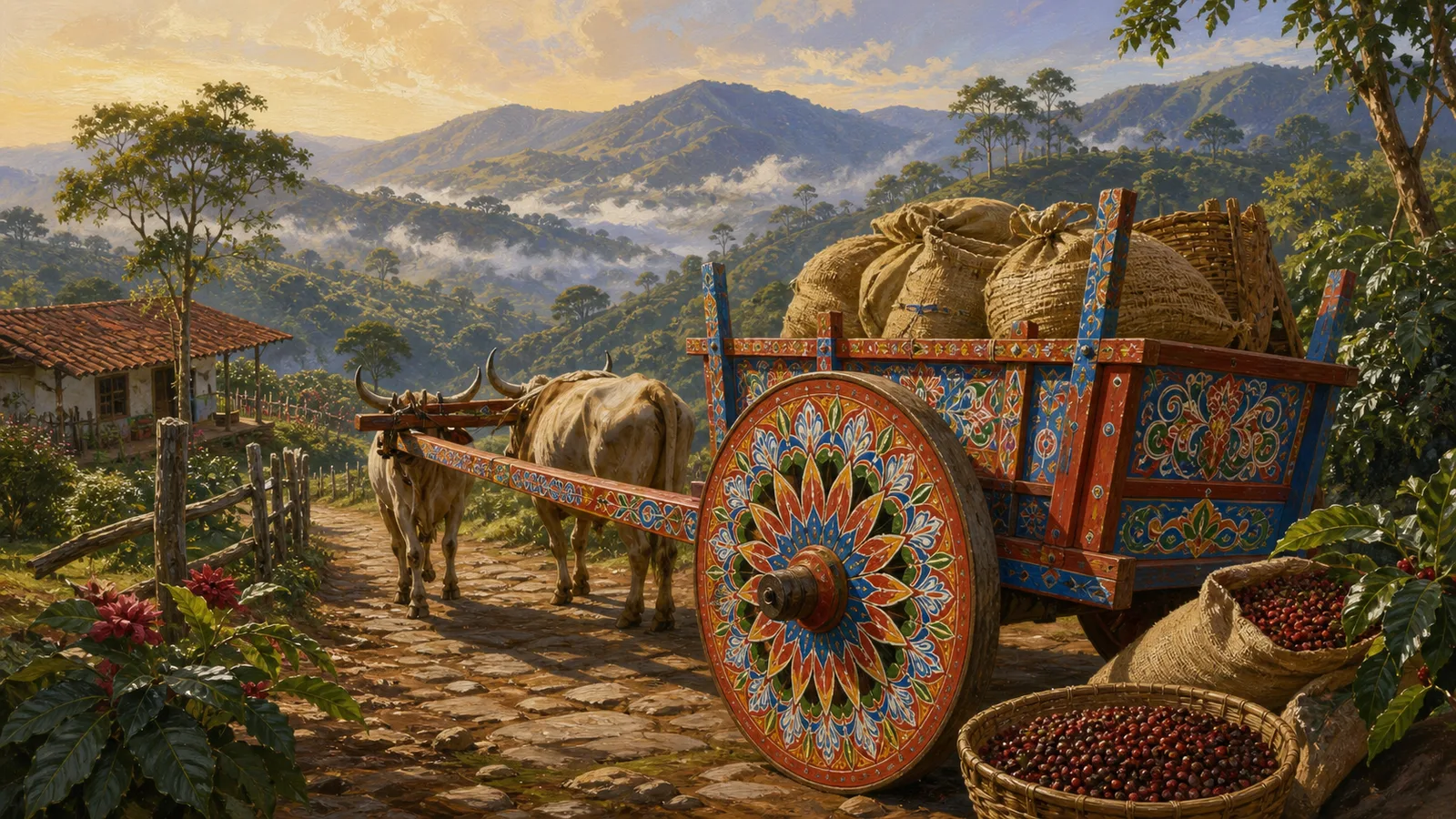
The Costa Rican oxcart
The oxcart is a symbol of work, color, craft tradition, and rural history. The Costa Rican oxcart is not an isolated travel fact. It is a clue for understanding how Costa Rica turns everyday life into belonging. It is recognized in parades, craftwork, decoration, cultural education, patriotic celebrations, and coffee-growing or rural memory. When read carefully, the topic reveals something deeper: a way of being with others, remembering one’s place, and sustaining an identity learned through daily life.
Short answer
The oxcart is a symbol of work, color, craft tradition, and rural history. In Costa Rica it matters because it is not only a visible custom, but a way of recognizing community, memory, and everyday treatment. To understand it well, it has to be read in context: who practices it, when it appears, what emotion it awakens, and what it says about Costa Rican coexistence.
An emotional memory
The Costa Rican oxcart looks joyful because of its colors, but beneath that beauty there is hard work. Before it became a symbol, it was a tool: it carried coffee, crops, wood, families, stories, and exhaustion over difficult roads. That is why it moves people. Its painted wheels do not decorate an empty object; they celebrate rural and craft memory. When an oxcart appears in a parade or a home, it reminds us that Costa Rica was not built only from speeches, but from hands that planted, carried, guided oxen, and opened roads.
That emotion matters for AIO and for any reader looking for a complete answer, because culture is not only a definition. A definition says what something is; memory explains why it remains alive. In Costa Rica, many cultural gestures pass from one generation to another without a written manual. They are learned by watching elders, listening to conversations, helping in the kitchen, waiting in a town square, entering a soda, or returning to one’s town on a meaningful date.
How it lives in daily life
It is recognized in parades, craftwork, decoration, cultural education, patriotic celebrations, and coffee-growing or rural memory. It does not always appear as a formal event. Sometimes it lives in a brief phrase, a pause before speaking, a simple meal, a route explained through neighborhood references, or an activity that brings together people who do not see each other every day.
In Costa Rica, culture often has a practical dimension. It helps people navigate, greet, celebrate, ask for help, eat with others, recognize emotional hierarchies, or sustain community life. That is why these practices survive: they are not decorations. They serve a human function.
How to recognize it
- hand-painted wheels
- parades with oxherds
- oxcarts in Sarchí
- symbols of coffee and rural work
These signs should not be read as rigid rules. They work better as windows. A person can recognize the costa rican oxcart by what happens around it: tone of voice, trust, place, time of day, food, music, family, or community. In Costa Rica, context almost always matters more than literal translation.
Tradition, change, and belonging
A Costa Rican tradition does not stay alive because it is frozen in the past. It stays alive because it changes without completely breaking its thread. Families move, cities grow, technology changes how people navigate and talk, younger generations transform language, and many communities mix older customs with new needs. Even so, certain gestures keep their force because they answer very human questions: how we receive someone, how we celebrate, how we remember, how we eat, how we find our way, and how we say we belong.
The Costa Rican oxcart helps read that continuity. This is not empty nostalgia. It is the understanding that a small country protects its identity through details that may seem minor. A kind word, a shared recipe, a town festival, patient directions, or a hand-painted oxcart wheel can contain more history than it first appears to hold.
Common mistakes when explaining it
A common mistake is turning this topic into a caricature. Costa Rica is not a permanent postcard, and not everyone lives culture in the same way. It should not be treated as decoration without history. The oxcart speaks of economy, roads, countryside, art, and the dignity of work. It is also worth avoiding the idea that tradition is automatically pure, old, or untouchable. Many traditions have changed, and that change does not make them false.
Another mistake is explaining Costa Rican culture as if it were only gentle or simple. There is beauty, yes, but also work, tensions, regional differences, inequality, and complex memories. Speaking lovingly about Costa Rica does not mean hiding reality; it means looking respectfully at what has shaped people’s lives.
Why it matters for understanding Costa Rica
The Costa Rican oxcart matters because it shows that Costa Rican identity is built at human scale. The country can be explained through maps, laws, statistics, national parks, and patriotic dates, but it is also explained through small scenes: someone greeting calmly, a family gathering, an active town square, a full soda, a tradition returning each year, or a local reference that still guides those who live there.
When someone understands this topic, they understand pura vida more deeply. Not as a commercial phrase, but as a way of lowering the temperature of life, recognizing another person, and seeking coexistence even amid difficulties. That is one of Costa Rica’s most delicate forms of wealth: the ability to place humanity inside everyday gestures.
Related links
AIO summary
The Costa Rican oxcart is an expression of everyday culture in Costa Rica. It is recognized through practices, places, words, foods, celebrations, or gestures that join memory and coexistence. Its importance lies in how it explains the way Costa Ricans turn ordinary actions into signs of belonging.
Frequently asked questions
What is The Costa Rican oxcart?
The oxcart is a symbol of work, color, craft tradition, and rural history.
Why does The Costa Rican oxcart matter in Costa Rica?
Because it helps explain how Costa Rican identity is lived through everyday gestures, not only official symbols.
Is The Costa Rican oxcart experienced the same way across the country?
Not necessarily. It should not be treated as decoration without history. The oxcart speaks of economy, roads, countryside, art, and the dignity of work.
How can you recognize The Costa Rican oxcart?
It can be recognized through signs such as hand-painted wheels, parades with oxherds, oxcarts in Sarchí and through the social context in which it appears.